
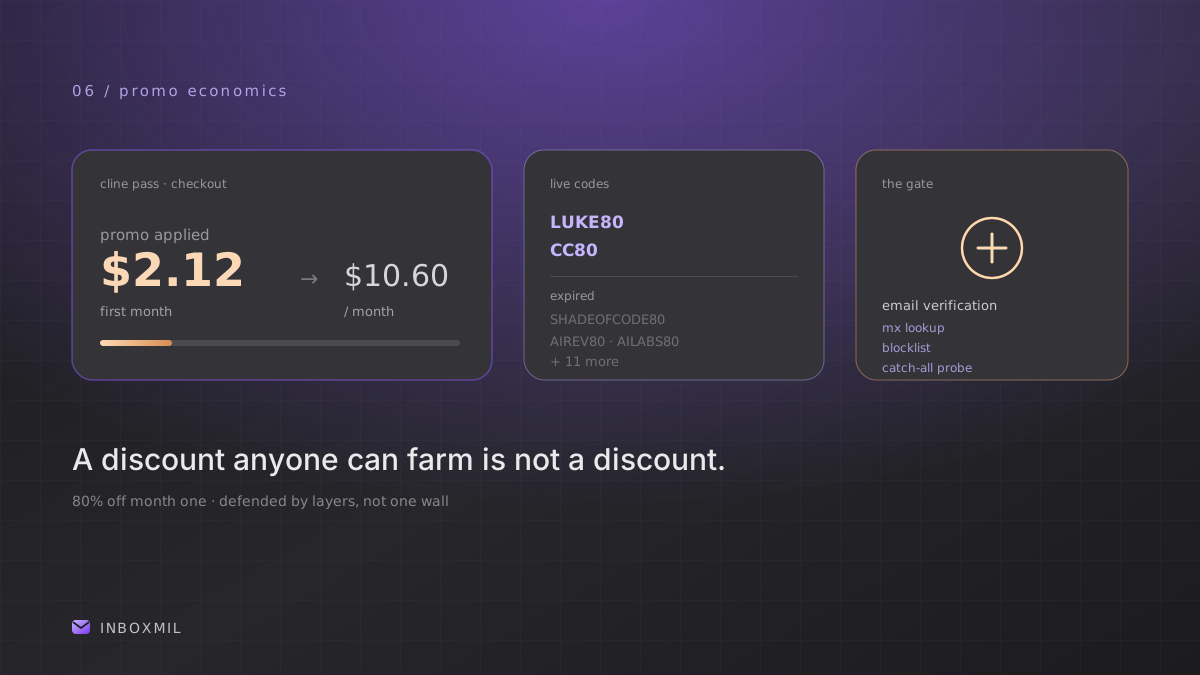
AI coding subscriptions got aggressively cheap in 2026. Cline Pass is advertised at roughly US$2.12 for the first month when you apply an official promo code at checkout, then about US$10.60 per month. Codes LUKE80 and CC80 are reported as still working, while a long list of earlier ones — SHADEOFCODE80, AIREV80, AILABS80, MEHUL80, and roughly a dozen more — have expired.
That pattern, a deep first-month discount rotating through influencer codes, is not generosity. It is a growth mechanic with a fraud surface attached, and the thing standing between the discount and unlimited abuse is usually an email address.
Why the first month is where the money leaks
A first-month discount is mathematically an invitation to churn: sign up cheap, cancel before renewal, repeat. Every SaaS company that runs this promotion accepts some of that as marketing spend. What they cannot accept is the same person doing it a hundred times, because at that point the promotion becomes a subsidy for a competitor's users.
The defenses fall into a rough order of cost:
- Card fingerprinting. Effective, but it blocks legitimate users who share a payment method and it is unavailable where payment is not the gate.
- Device and network signals. Cheap to compute, easy to defeat with a different network, prone to false positives on shared or mobile address space.
- Email verification. Weak on its own, because a throwaway address costs nothing. Strong when combined with something else, and it is the only one of the three that also gives you a channel to reach the user.
That last point explains why an email gate survives even when it is trivially defeated in isolation. Verification is not only an abuse filter; it is the step that turns an address into a support channel, a billing contact, and a way to recover an account.
What a check actually costs the operator
A basic gate is one API call: take the domain part of the address, compare it against a set of known throwaway domains, reject on a hit. The blocklist discussed elsewhere in this blog carries 9,927 domains in a flat file, so the lookup is a hash set membership test — microseconds, no network hop if cached.
That catches the lazy case. It does not catch a domain registered last week, which is why the second layer is usually a live MX lookup: does this domain accept mail at all, and does it accept mail for any local part. A catch-all domain answers yes to everything, which is a strong signal that the address was manufactured rather than chosen.
The economics the promo implies
If the first month is $2.12 and the steady state is $10.60, the promotion is roughly an 80 percent discount on month one. The company is betting that a meaningful fraction of discount users convert to full price. Farming breaks that bet: a farmed account is guaranteed to pay $2.12 and guaranteed to cancel, so every farmed signup is a straight loss with compute attached — and AI coding agents are compute-heavy, so the loss is larger than it would be for a storage product.
That is the specific reason AI tool subscriptions gate harder than most. A free trial of a low-marginal-cost product can absorb abuse. A trial of an LLM-backed agent cannot, because the trial itself consumes inference the company pays for.
What this means if you are on the other side
If you build an agent and you need to test your own signup flow, a disposable inbox is the right tool: mint, receive, extract, delete, and never touch a real identity. If you are trying to obtain a service's paid tier for free, the email gate is not the obstacle to solve — the discount exists to acquire customers who stay, and routing around it is the abuse the gate was built for.
The honest split is straightforward. Testing your own flow: automation is fine. Testing someone else's onboarding to farm a promotion: that is the thing the MX lookup and the blocklist exist to stop, and they get better every quarter.
The takeaway
Cheap first months and rotating influencer codes are a customer acquisition strategy with a known leak, defended by layered signals where email verification is the cheapest and most durable layer. Read a promo like LUKE80 as a marketing budget line, not a loophole. The gate is not there to annoy developers — it is there because the alternative is paying for someone else's compute.