
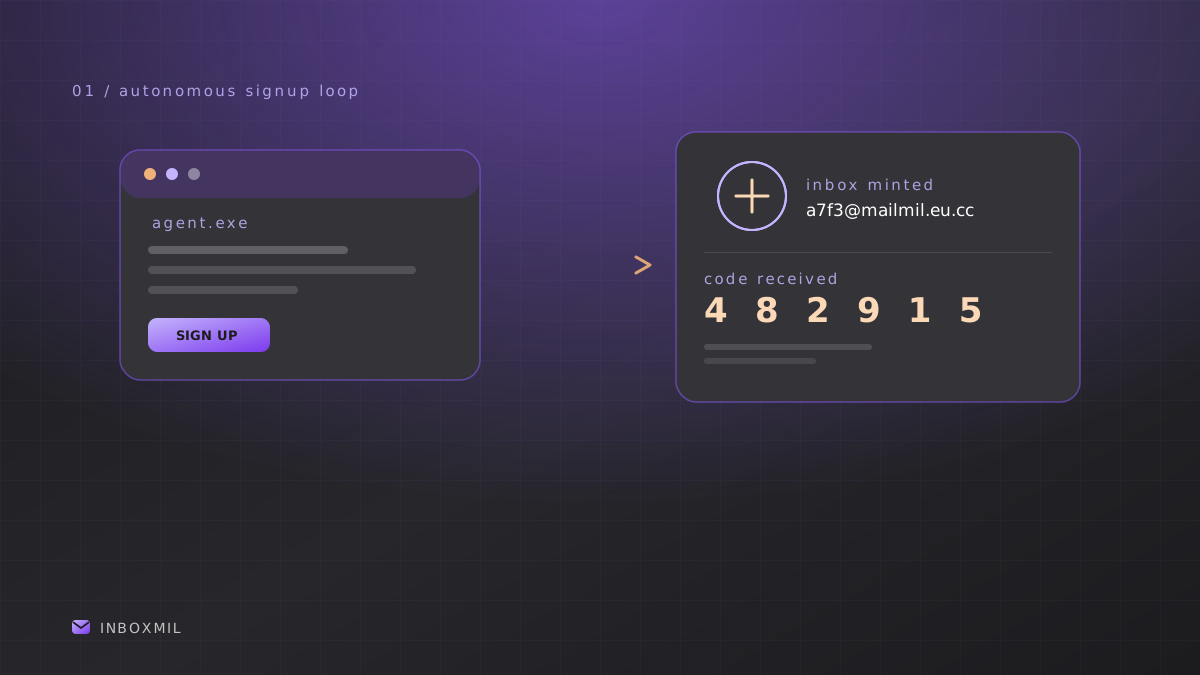
An autonomous agent can draft the code, run the tests, and open the browser. Then it hits the one step every signup flow guards: the confirmation email. The agent has no inbox, so the run stops at a screen it cannot pass. That is the actual bottleneck in agent-driven workflows, and it is why disposable mail APIs have quietly become infrastructure for AI tooling.
The agent stack already exists
The tooling for browser automation is mature enough that the missing inbox is conspicuous. Playwright sits at 98,410 GitHub stars on a v1.64.1 release cut on 14 October 2026. Puppeteer is at 95,737. Browser Use, the Python library that wraps browser automation for LLM agents, is at 119,021 stars with 0.13.13 shipped on 15 October 2026. Cline, the agent that works as an SDK, IDE extension, and CLI, is at 70,806 stars under Apache-2.0.
Every one of those tools can fill a form, solve a checkbox, and submit. None of them can read a mailbox. That gap is where a human still has to step in, hand over a code, and unblock the run. For a workflow that is supposed to be autonomous, that is a hard stop.
What the loop actually needs
The requirement is narrower than "email." It is four operations, in order:
- Mint an address that will receive mail right now.
- Poll that address until a message lands, without hammering the server.
- Extract the verification token or one-time code from the message body.
- Delete the address so the next run starts clean.
A REST surface that exposes exactly those four is all an agent needs. In Inboxmil's own API the calls are POST /addresses, GET /inbox, and DELETE /addresses/{id}, with the OTP parsed server-side and returned on the message row. Three calls to a code.
Why not a real mailbox
Three practical reasons, and none of them are about hiding anything:
- Isolation. A test run should not touch an identity that has other things attached to it. A throwaway address per run means a broken test cannot poison a shared inbox.
- Cleanup. A real mailbox accumulates. A disposable one expires on its own schedule, so the state a test sees at minute zero is the same state at minute five hundred.
- Concurrency. Ten parallel agent runs need ten addresses that cannot read each other's mail. Minting is cheaper than provisioning.
The rate limit is the real design constraint
Anyone who has wired this up has hit the same wall: the mail provider caps address creation. Inboxmil's own anonymous path allows 10 addresses per network per 24 hours by default, tracked in the rate_limits table and bucketed by /64 for IPv6. The default provider-level quota is 10 addresses per key unless a plan raises it. A test suite that mints freely will exhaust both within a morning.
Two fixes, and they are different problems. First, reuse: poll the existing address for the duration of a run instead of minting per assertion. Second, delete what you mint. An address that is soft-deleted stops counting against the quota, so the ceiling is a function of concurrently live addresses, not of total runs.
What this does not solve
To be precise about the limits: a disposable address will be rejected by any service that checks against a blocklist. The community blocklist at disposable-email-domains/disposable-email-domains, a 5,614-star repository, currently carries 9,927 domains and grows steadily. Services that run that check are explicitly asking for an address that will not be thrown away, and an agent using a throwaway inbox there is using the wrong tool. The loop above is for testing your own flows, staging environments, and integrations you control, not for farming accounts on someone else's platform.
The takeaway
An agent that cannot receive mail is an agent that stops at the second-to-last step. Wiring a disposable inbox into the loop turns a human-gated workflow into an autonomous one, and the whole integration is three HTTP calls and a delete. The interesting part is not that it works. It is that so much agent tooling shipped before anyone closed this gap.